Record 007
What is physical AI?
IDENTITY
| No. | 007 |
|---|---|
| Category | glossary |
| Record basis | Concept / AI illustration |
| Originally published | unrecorded |
OBSERVED
What changes when intelligence leaves the screen? The original post starts with that question. Physical AI connects perception and reasoning to action in the physical world; NVIDIA's glossary describes autonomous systems in those terms. It is not limited to a human-shaped machine.
The card follows a simple chain: data and models, agents, robots and machines, then the physical environment. This is B2AGI's explanatory framework, not a mandatory architecture for every robot. Humanoids, autonomous vehicles, drones, factories, logistics and retail are areas to investigate, not a list of already-proven autonomous operations.
In a real task, the questions become specific. What does the system sense? How does it select an action? What changes when the surroundings change, and who intervenes when it cannot continue? Putting AI inside a machine does not by itself establish safe, reliable or economical operation.
That is why B2AGI follows the transition from demonstration to deployment and everyday use. The original phrase about AI learning to act is a way to frame that transition, not a claim that earlier robotics never sensed or acted. The illustrations explain the concept; they are not field evidence about the depicted machines.
Written from the supplied media and the cited sources. This is distinct from the original Instagram caption. Publication and media-rights review remain pending.
2026-09-18 · Original media retained; three-language web text added with explicit evidence limits. The earlier local review was followed by the first public web edition on this date.
2026-09-18: restored the original explanatory chain and application areas; separated the editorial framework from evidence of actual operation.
First web edition: 2026-09-18 · Web edition updated: 2026-09-18 Web dates are separate from observation and original-post dates.
Shared subject; each record retains its own evidence limits.
Original caption — preserved as published
WHAT IS PHYSICAL AI? 🤖 For most of the AI era, intelligence lived behind a screen. It could search. Predict. Recommend. Generate. Reason. But it couldn’t physically act in the world. That is beginning to change. Physical AI brings intelligence into machines that can perceive their environment, make decisions, move — and interact with the real world. Humanoid robots. Autonomous vehicles. Drones. Smart factories. Intelligent logistics. But Physical AI isn’t simply about putting AI inside a robot. The real transformation happens when intelligence connects with: Data → Models → Agents → Machines → Physical World And that creates a much harder challenge than software alone. A Physical AI system must work with uncertainty. It must understand its surroundings. It must make decisions in real time. And eventually, it must operate safely, reliably and economically outside controlled demonstrations. That’s why B2AGI isn’t only watching what robots can do on stage. We’re watching what happens when intelligence enters factories, vehicles, infrastructure, businesses — and everyday life. AI learned to understand the world. Now it’s learning to act in it. And that may be one of the most important transitions of the AI era. 🔎 Demo → Deployment → Reality 🌍 B2AGI Global Field Intelligence We go where intelligence becomes physical.
#PhysicalAI #Robotics #EmbodiedAI #ArtificialIntelligence #B2AGI
PRESERVED MEDIA
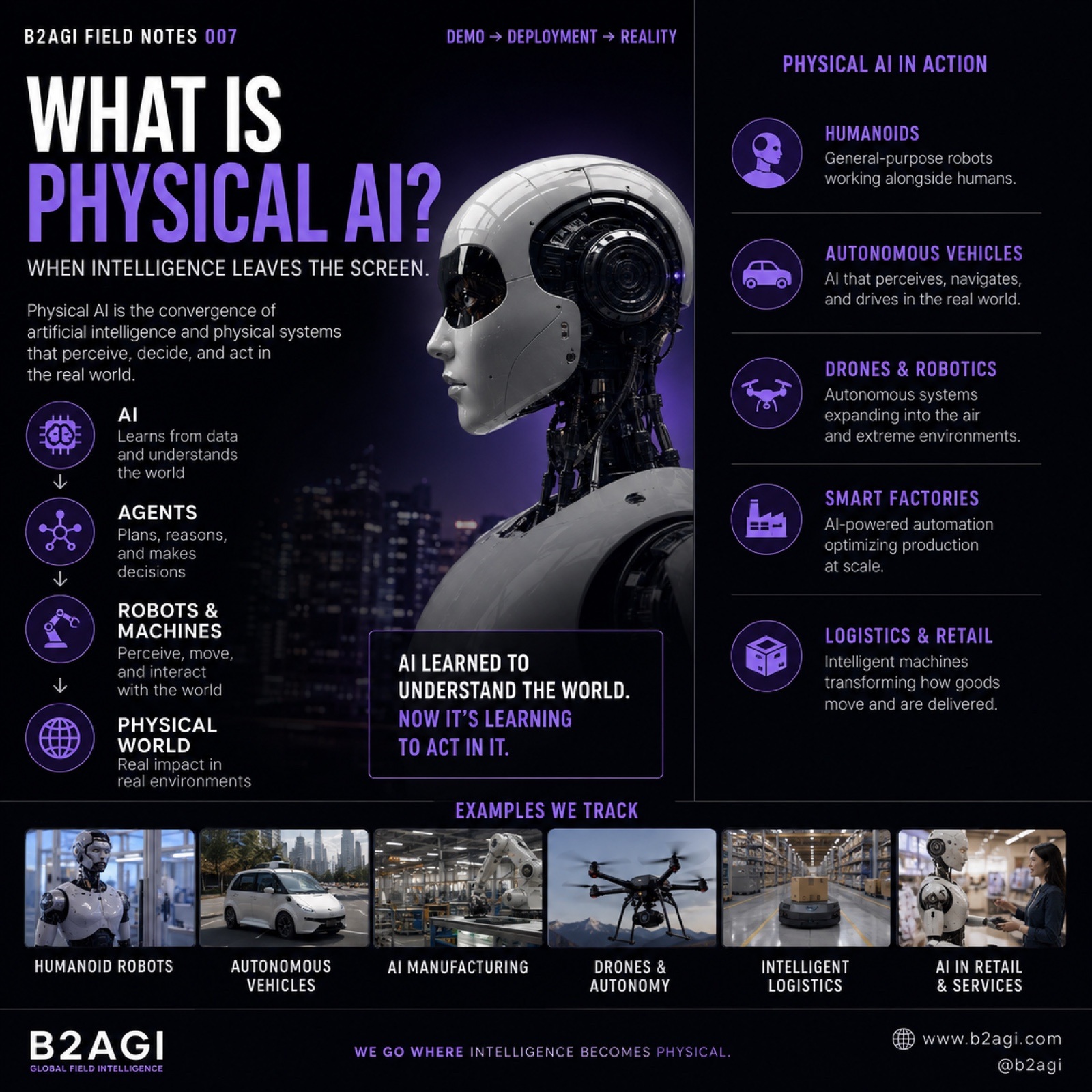
Original media. Embedded text and audio remain in their source languages; this is not a dubbed or translated media edition.
CLAIMED
unrecorded
PERSISTENCE
| status | historical_record |
|---|---|
| intervention rate | not measured |
| uptime | not measured |
| next check | unrecorded |
UNKNOWN / OPEN
Editorial note This explainer introduces working terms. Translations should preserve the distinction between demonstrations, deployments and measured operating performance.
EVIDENCE / SOURCES
- Original publication (legacy URL — redirects here) ↗
- /archive-media/7/ — Original media (preservation pending — not embedded)
RELATED / NEXT
TRACE STATUS
record · restored 2026-09-26 from the original publication of unrecorded