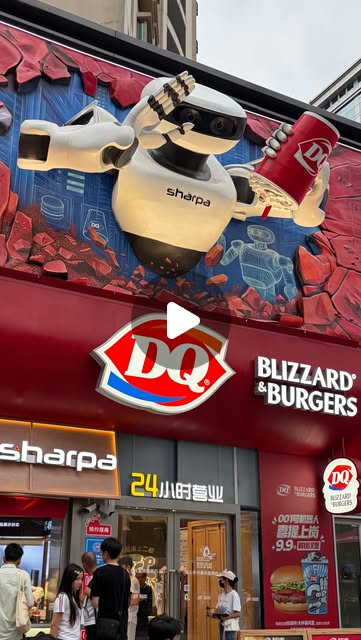
SHANGHAI — On September 1, I walked into DQ Blizzard & Burgers at Sijifang, 169 Wujiang Road in Jing'an District, paid for a Blizzard, and watched a humanoid robot prepare my order. The entrance is on the Shimen 1st Road side. That sentence sounds like a product launch. The more useful question is what actually happened between the order and the ice cream.
Store branding and published material from Sharpa and Yicai identify the machine as Sharpa North, a wheeled humanoid installed behind a dedicated counter. It worked with recognizable store equipment rather than performing on an exhibition stage. I watched and recorded the visible preparation sequence and received the product. I did not conduct a frame-by-frame operational audit, and this visit cannot exclude assistance outside my field of view or portions not preserved in the published clip.
That combination matters. This was more than a looping showroom gesture, but less than proof that a humanoid can independently run a restaurant shift. B2AGI's method is to follow the path from Demo → Deployment → Reality: first establish what was shown, then identify the operating environment, and finally ask whether the system can keep working under ordinary pressure.
What I directly observed
- I entered as an ordinary paying customer and placed an ice-cream order.
- The machine identified by store and published sources as Sharpa North performed the visible preparation sequence behind the counter.
- The robot manipulated cups and store equipment in a live retail environment.
- I received the ordered item after the sequence I observed.
- My impression was that the process was slow; I did not conduct a timed, same-order comparison with an employee.
This report documents one customer visit, not an operational audit. It supports a narrow conclusion: I observed a humanoid perform the visible preparation sequence associated with one paid order in an operating store and then received the product. It does not establish the robot's uptime, intervention rate, labor economics, safety record, throughput during peak hours, or performance across a varied menu.
What other sources add
Sharpa's “North at Work” account describes the Blizzard workflow as a sequence of roughly 50 to 60 manipulation steps using existing equipment and says North performs the process autonomously. Those are vendor claims; my visit did not independently inspect the control stack or rule out remote assistance outside my field of view.
Yicai Global reported on Sep 1, 2026 that its reporter visited on the robot's first day, observed about six minutes per cup versus two to three minutes for an experienced worker, and found the robot-made offering limited to Oreo flavor at that launch stage. These conditions belong to Yicai's visit and should not be silently treated as measurements from mine. The Paper reported on Aug 30, 2026 that cost, efficiency, and stability remained barriers to scale. These reports substantially overlap in sources and timing, so they are supporting accounts, not multiple independent replications.
Deployment is not the same as scale
The strongest part of this installation is not that the machine looks human. It is that a general-purpose form is being tested inside a constrained commercial workflow, around customers, ingredients, tools, and brand expectations. Restaurants expose robotics to repetition, contamination risk, variable demand, maintenance, and the simple impatience of a queue.
The weakest interpretation would be to treat one successful order as evidence that the economics already work. A useful deployment report needs denominator data: orders attempted, orders completed without intervention, average cycle time, downtime, cleaning and maintenance labor, error recovery, safety incidents, and total cost per completed order.
The next questions
If Sharpa North remains in service, the most important update will not be another polished video. It will be evidence about repeated operation: Does cycle time improve? How often does a person intervene? Can the menu expand? What happens during rush hour? Does the system reduce total workload after supervision and maintenance are counted?
One completed order is a useful observation. The next question is whether the system can repeat that result reliably, with manageable human intervention and cost.
About B2AGI
B2AGI — Business to AGI publishes firsthand field reporting and analysis on AI, robotics, and their implications for business. Its current focus is Physical AI deployment: what works beyond the demo, under what conditions, and with what evidence.
Sources and provenance
- Henry Chan Jung / B2AGI original field recording, observed Sep 1, 2026.
- Shanghai Jing'an District official store introduction, confirming 169 Wujiang Road, Sijifang, and the Shimen 1st Road-side entrance.
- CFB Group: DQ × Sharpa robot restaurant announcement, identifying DQ Blizzard & Burgers on Wujiang Road.
- Sharpa: North at Work, vendor description and technical claims; accessed Sep 14, 2026.
- Yicai Global: Humanoid Robot Starts Work at Dairy Queen's 24-Hour Shanghai Ice Cream Parlor, Sep 1, 2026.
- The Paper: 人形机器人冰淇淋店打工,成本、效率、稳定性仍是规模化门槛, Aug 30, 2026.
Update, Sep 16, 2026: Added the verified store name, street address, and entrance orientation.
Corrections: b2agi@icloud.com. Material corrections will be recorded with a revised timestamp.