Record 005
Physical AI in Shenzhen
IDENTITY
| No. | 005 |
|---|---|
| Category | regional |
| Record basis | Desk research |
| Originally published | unrecorded |
OBSERVED
Shenzhen's 2025–2027 action plan links robot components, computing, models, testing and manufacturing. It is useful as a checklist of the ecosystem the city intends to develop, not evidence that every target is already met.
One figure needs clarification: the plan targets more than 50 application scenarios, each at the billion-yuan scale, by 2027. This is a scenario-count target, not a measured combined market of RMB 50 billion. The card's compressed wording should be read with this correction.
The follow-up question is which announced scenarios become operating sites, with a named task, responsible operator and repeatable results.
Written from the supplied media and the cited sources. This is distinct from the original Instagram caption. Publication and media-rights review remain pending.
2026-09-18 · Original media retained; three-language web text added with explicit evidence limits. The earlier local review was followed by the first public web edition on this date.
First web edition: 2026-09-18 · Web edition updated: 2026-09-18 Web dates are separate from observation and original-post dates.
Shared subject; each record retains its own evidence limits.
Original caption — preserved as published
PHYSICAL AI IN SHENZHEN 🇨🇳 If Beijing is where intelligence is being tested, and Shanghai is where it meets the real world, Shenzhen is where the physical layer gets built. For decades, Shenzhen has been one of the world’s most important manufacturing ecosystems for electronics and advanced hardware. Now that same ecosystem is moving into Physical AI. Motors. Sensors. Batteries. Actuators. Controllers. Chips. Drones. Robots. The interesting part isn’t any single machine. It’s the ecosystem behind the machine. In Shenzhen, ideas can move from prototype to manufacturing with extraordinary speed — supported by dense supply chains, engineering talent and an enormous hardware ecosystem. And the city wants to push much further. Shenzhen’s Physical AI strategy targets more than 1,200 embodied-intelligence-related companies and an associated industry exceeding RMB 100 billion by 2027. But those are targets — not outcomes. The harder questions are: Can manufacturing speed become a lasting advantage? Can software intelligence advance as quickly as the hardware? Can humanoid robots become reliable and economical enough for real work? And can Shenzhen turn its supply-chain advantage into a global Physical AI advantage? Because the future of robotics won’t be decided by the most impressive prototype. It will be decided by who can build it, improve it, deploy it — and scale it. Beijing tests the intelligence. Shanghai brings it into the real world. Shenzhen builds the physical layer at scale. 📍 Shenzhen, China 🇨🇳 🔎 Demo → Deployment → Reality 🌍 B2AGI Global Field Notes We go where intelligence becomes physical.
#PhysicalAI #Shenzhen #Robotics #EmbodiedAI #b2agi
PRESERVED MEDIA
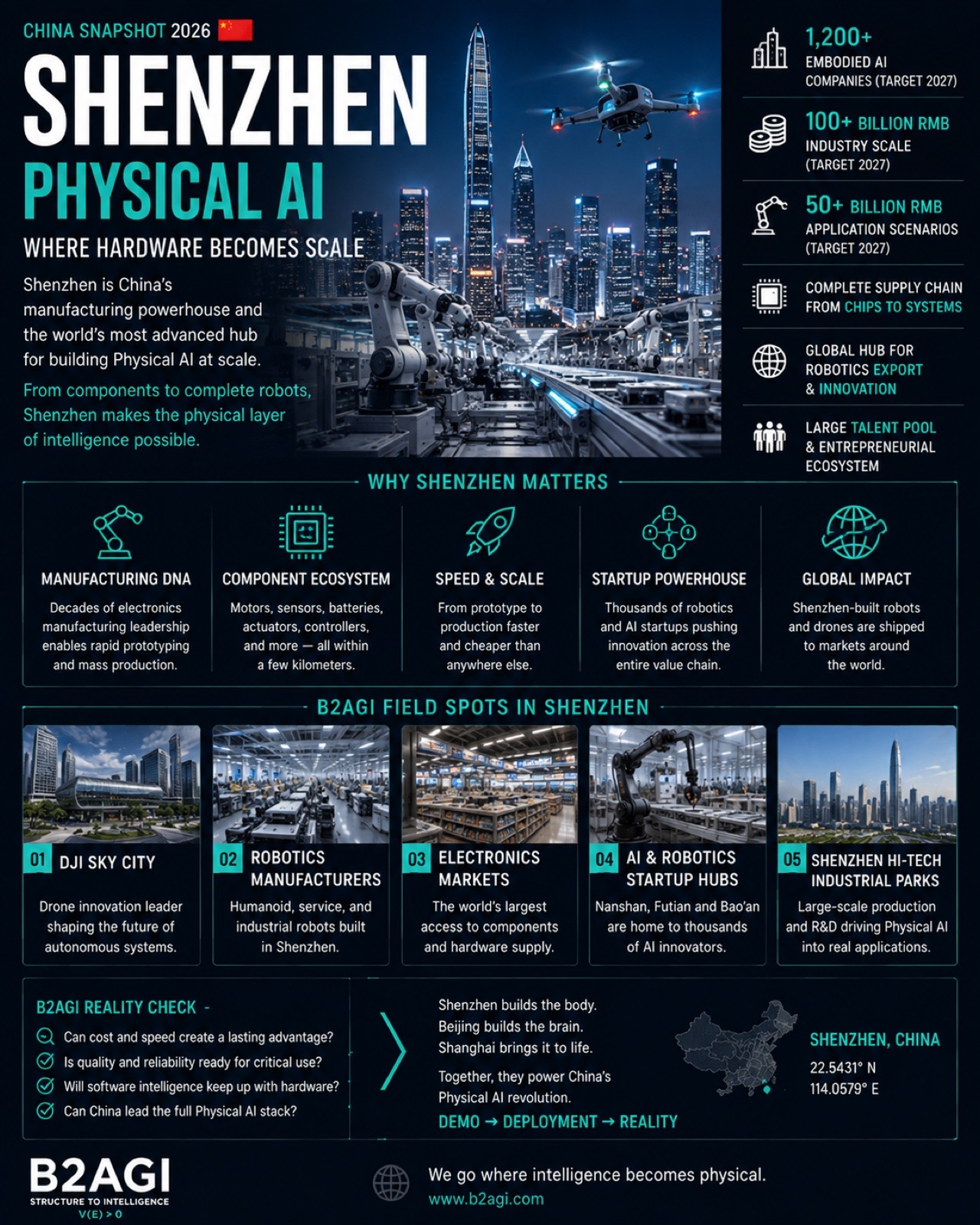
Original media. Embedded text and audio remain in their source languages; this is not a dubbed or translated media edition.
CLAIMED
unrecorded
PERSISTENCE
| status | historical_record |
|---|---|
| intervention rate | not measured |
| uptime | not measured |
| next check | unrecorded |
UNKNOWN / OPEN
Editorial note This regional overview is editorial context. Its illustrations and maps are not evidence that every depicted product or facility was observed on site.
EVIDENCE / SOURCES
- Original publication (legacy URL — redirects here) ↗
- /archive-media/5/ — Original media (preservation pending — not embedded)
RELATED / NEXT
TRACE STATUS
record · restored 2026-09-26 from the original publication of unrecorded